
Cable News Is Not a Radio Product
Dumping a 24/7 TV audio feed onto TuneIn and calling it radio isn't a strategy. It's a shortcut.

This is my opinion as someone who works in broadcasting and spends probably too much time thinking about radio. Take it for what it is.
Cable news channels have the infrastructure, the staff, the brand recognition, and the content volume to build genuinely compelling audio products. They have people who know how to talk and news gathering operations most radio stations can only dream of.
Instead, they route the 24/7 TV audio feed to a streaming platform and call it done.

CNN is on TuneIn. Fox News is on SiriusXM. MS NOW has a linear feed on TuneIn as well. You can listen to all of them. But listening to TV without the picture isn’t the same thing as audio, and the fact that you can technically do it doesn’t make it a radio product.
Real audio is built around the assumption that you cannot see anything. The writing accounts for it. The pacing accounts for it. When something visual happens, someone describes it. When there’s a graphic, someone reads it. When there’s a clip, the anchor sets it up so you know what you’re about to hear and why it matters. None of that is complicated, but all of it is deliberate.
TV assumes you’re watching. When an anchor says “as you can see here” and pauses while a map fills the screen, audio listeners get silence and no idea what they were supposed to be seeing. When a breaking news chyron goes up, it doesn’t go anywhere on audio. It just sits there as invisible text nobody reads aloud because everyone in the studio assumes you can see it.
That’s not a small problem. That’s the whole product.
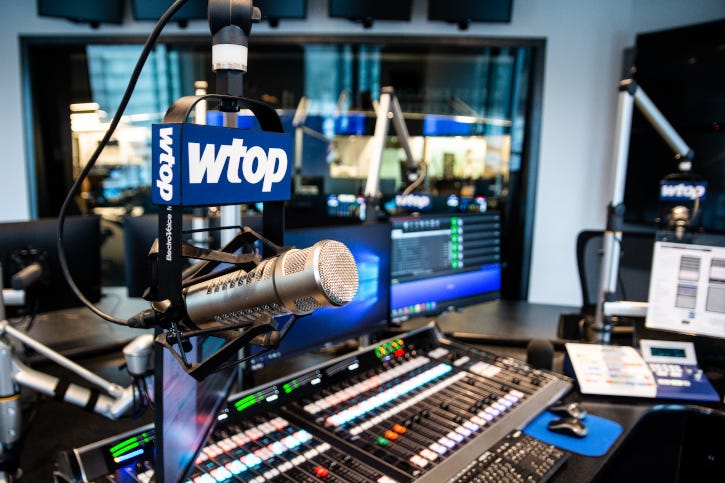
The proof that it can be done differently isn’t hard to find, and you don’t have to leave the country to find it. WTOP in Washington D.C. has been running commercial all-news radio since 1969. Traffic and weather on a regular cycle, written for listeners, paced for listeners, ads sold against all of it. It consistently ranks as the highest-rated radio station in the D.C. market -- not the highest-rated news station, the highest-rated station period -- and has the Murrow Awards to back it up. It built a great audio product and sold ads against it for over fifty-five years.
The BBC and CBC get brought up in conversations like this because they did the same thing at a larger scale and earlier. BBC Radio and CBC Radio were built as distinct operations from their television sides, written and produced specifically for listeners. CBC Radio has been commercial-free since 1974. The BBC runs on the TV licence fee. Those funding models are real differences, and anyone who says they don’t matter is wrong. But WTOP is right there as evidence that the commercial-free argument is a deflection. The question was never about the funding model. It was about whether you treat audio as its own discipline or as a TV byproduct. All three answered that question the same way, just with different revenue structures behind it.

If the business case for a fully produced commercial feed is still a tough sell internally, SiriusXM and TuneIn already have the infrastructure for tiered models, a standard ad-supported feed and a premium ad-free option. That’s not a novel idea. Neither the production problem nor the monetization problem is actually hard to solve.
MS NOW is worth noting here because they’re doing both things simultaneously. Their podcast operation is legitimate. Rachel Maddow Presents: Ultra earned an Edward R. Murrow Award in 2025, and those narrative series are produced for ears, not repurposed from TV. The criticism isn’t about that work. It’s specifically about the live 24/7 feed that gets dumped on a streaming platform and called radio.
The national news audio space isn’t crowded. Public radio serves a different mission. There’s real room for a cable news operation to build something audio-first. The audience exists. The content pipeline exists. The talent exists. What’s missing is the decision to treat the live feed as something other than a TV byproduct.
Nobody is choosing TuneIn CNN because it’s a great radio product. They’re there because it’s available and the brand is familiar. That’s inertia, not a product strategy.
WTOP has been answering this question since 1969. Cable news just hasn’t bothered to ask it.