
Ted Turner Didn’t Just Build a Network. He Exploited a Satellite Loophole.
The story of WTCG Channel 17 is really a story about what happens when someone points a dish at the sky and refuses to ask permission first.

Ted Turner died on May 6, 2026. He was 87. Most of the tributes are going to focus on CNN, on the Gulf War coverage, on the $1 billion he gave to the United Nations. All of that is real and worth discussing. But from a broadcast technology perspective, the most interesting thing Ted Turner ever did happened on December 17, 1976, at a satellite uplink in Atlanta.
That’s the day he beamed a struggling UHF station up to RCA’s Satcom 1 and turned local television into something the industry hadn’t named yet.
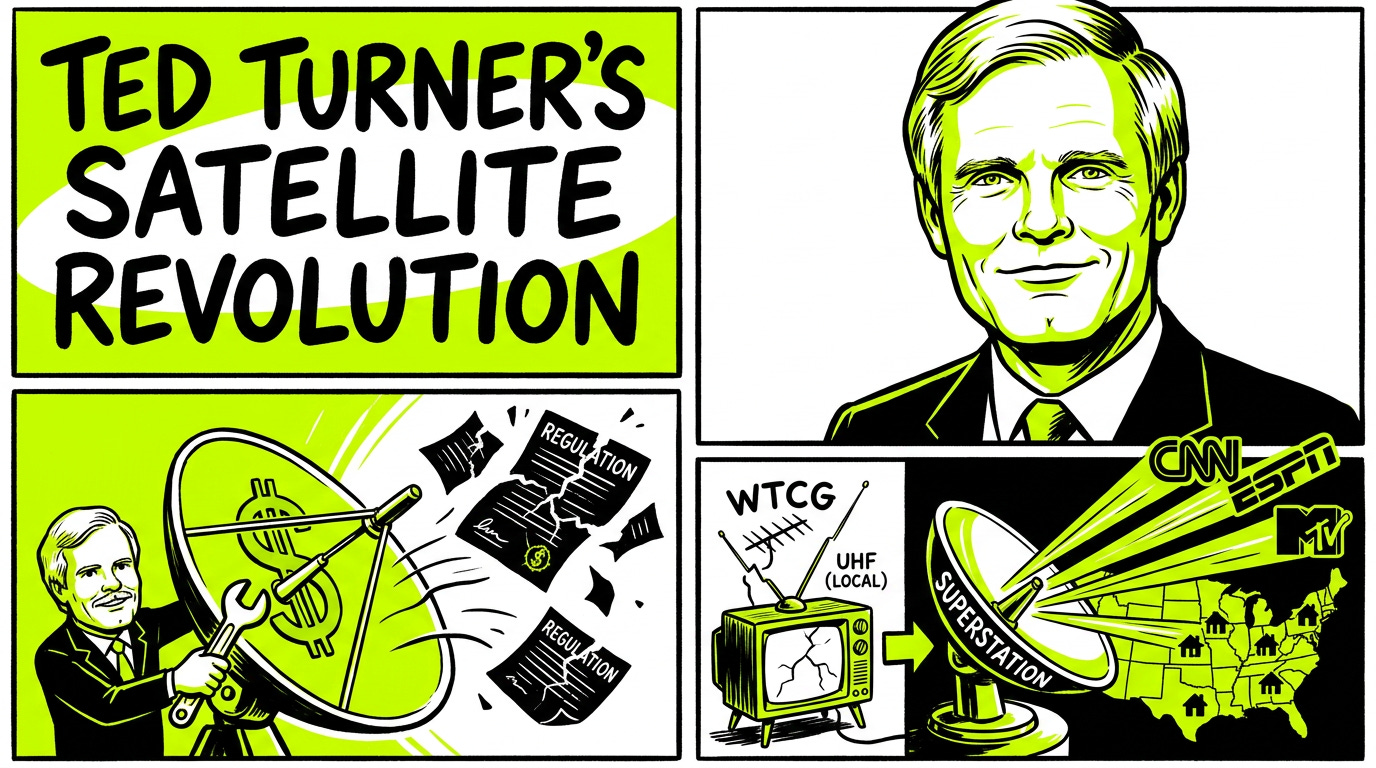
WTCG was Channel 17 in Atlanta, a money-losing UHF station Turner had acquired six years earlier in exchange for a couple of radio properties. UHF was a graveyard in 1970. The FCC had mandated all-channel tuners in TVs just five years before, so the receivers existed, but nobody was watching. Turner programmed it cheap and scrappy: old movies, reruns, wrestling, and Atlanta Braves games. He made it profitable by 1973 on pure volume and low rates, not because anyone outside Atlanta had a reason to care about it.
What changed was HBO.
In September 1975, HBO transmitted the Ali-Frazier “Thrilla in Manila” fight from a ground station in Vero Beach, Florida, up to Satcom 1, and back down to cable headends across the country. It was the first commercial satellite delivery of a cable signal in the United States. Turner saw it and immediately understood what it meant: the satellite didn’t care where your signal came from or what size your market was. If you had an uplink and the dish-to-dish connection, your local station was suddenly everywhere.
The regulatory framework had not caught up to this idea. Turner’s lawyer, Tench Coxe, found the gap: a 1972 FCC “Open Skies” policy had deregulated domestic satellite use to encourage competition. Nobody had thought to close the loophole that let a local broadcaster use that infrastructure to distribute nationally. Turner didn’t wait for permission. He negotiated transponder time on Satcom 1 for roughly $1 million a year, built a ground station at the station’s transmitter site, and on December 17, 1976, WTCG went national.
Cable operators had a real problem: they were selling subscriptions but didn’t have enough content to justify the price. Turner solved it. WTCG was advertiser-supported, so retransmission was free, and the FCC’s distant signal rules had never been written with satellite distribution in mind. Within two years, more than two million cable subscribers were watching Channel 17 Atlanta from places that had never heard of the Atlanta Braves.
The word “superstation” came from that gap. It wasn’t a regulatory category, it was a description of what accidentally happened: a local station with a satellite uplink and enough cable carriage to function as a national network without any of the obligations that came with being one. No owned-and-operated stations, no affiliates, no prime-time clearance requirements, no FCC scrutiny beyond the home market.
Turner renamed it WTBS in 1979. Within a decade, the model had seeded ESPN, MTV, and The Weather Channel. All of them owed their distribution economics to the same principle: satellite is distance-agnostic, and if the rules don’t say you can’t, maybe you can.
He bought the Atlanta Braves the same year he went national. That wasn’t a vanity move. That was vertical integration. The team was programming the superstation needed that nobody else could simulcast, and Turner owned it outright.
None of this required genius. It required someone willing to read a regulatory gap as an invitation rather than an oversight, and to move before anyone thought to close it. The broadcast engineers who built that uplink in 1976 were solving a straightforward RF problem. What Turner understood was that the business problem and the technical problem had the same solution, and that the FCC hadn’t written any rules to stop him.