Yandex Went Quiet. Did Your Comment Section?
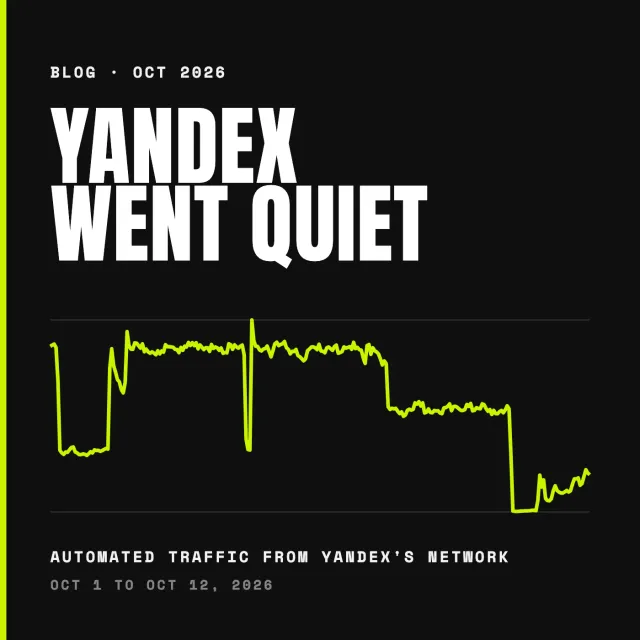
Between October 8 and 11, Ukrainian drones hit three Yandex data centers: Sasovo, Kaluga and Vladimir. Yandex says Vladimir was completely suspended. A few days later a Cloudflare Radar chart was everywhere, showing automated traffic from Yandex’s network falling off a cliff.
Then came the claim that goes with it: the bots are gone and the internet got quieter.
Some of that is real. Some of it isn’t. I pulled the data myself.
What the chart shows
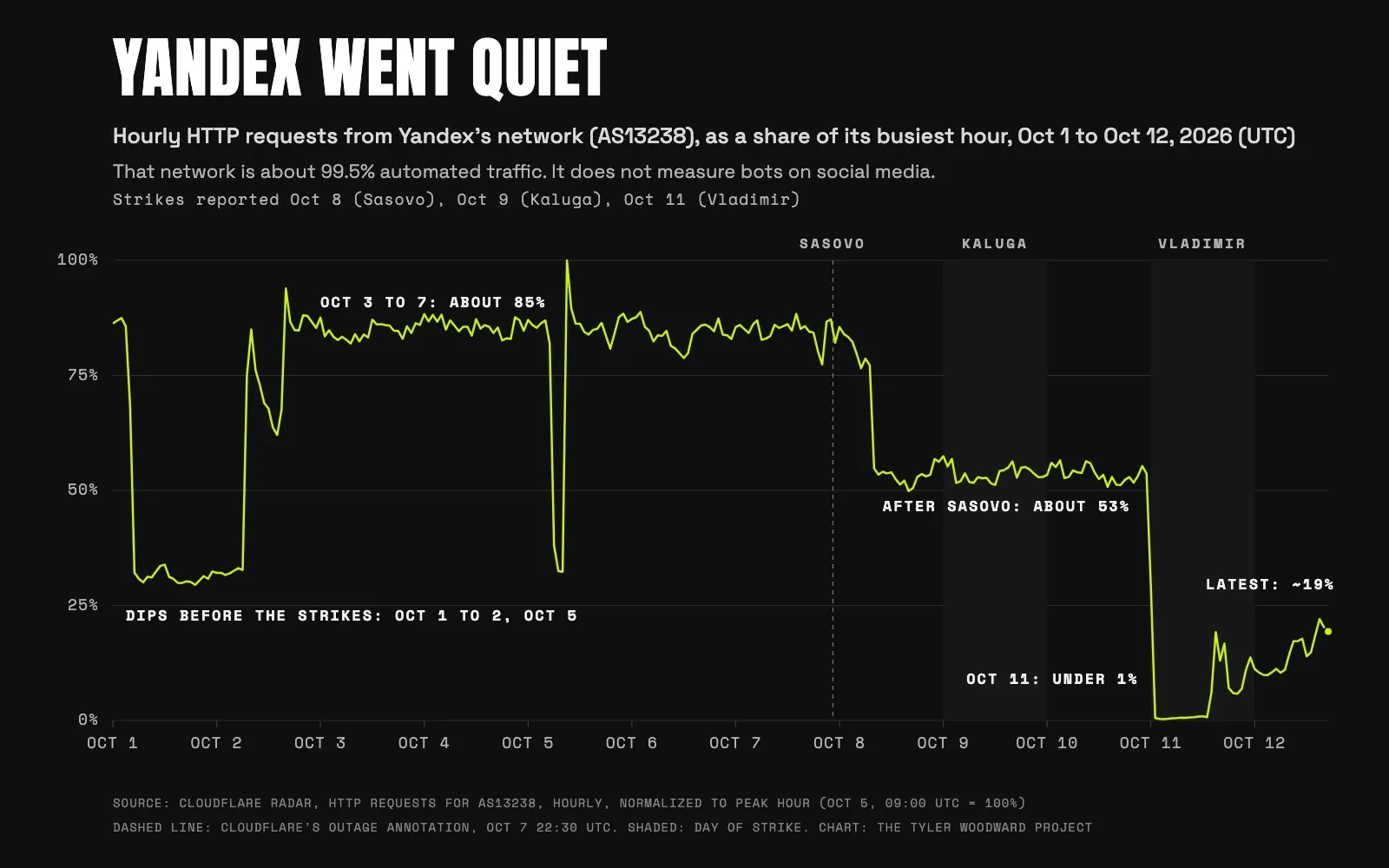
This is Cloudflare Radar’s hourly request count for AS13238, Yandex’s network, scaled so its busiest hour is 100%. About 99.5% of that traffic is classified as automated.
From October 3 to 7 it sat around 85%. After the Sasovo strike it stepped down to roughly 53%. On October 11, after Vladimir, it fell under 1%. By the evening of October 12 it was back to about 19%.
It also dipped on October 1 to 2 and again on October 5, before any strike. So this network was never a flat line, and the October 11 drop is the part I’d trust.
What it doesn’t show
It shows requests coming out of Yandex’s own network, and a big share of that is a search engine doing what search engines do: crawling websites to index them. Lose data centers, lose crawlers.
It does not show accounts posting on Facebook, X or anywhere else. The person behind @antibot4navalny, which tracks propaganda and troll networks, told RFE/RL the chart has little to do with malicious social media bots. RFE/RL and Cybernews both report researchers making the same point.
So “bot activity fell across the world” isn’t something this data supports. I looked for a worldwide drop in spam or bot traffic and didn’t find one. If you’ve seen a source that measured one, send it to me.
The claim
Zelenskyy said at the Warsaw Security Forum on October 12 that it had become “a little easier to breathe” on many social media platforms. A Czech MEP posted the chart and tied it to a drop in AfD-related activity, and people have said similar things about MAGA and Reform UK accounts.
Those are statements and anecdotes, not measurements. They might turn out to be true. Nobody has shown it yet.
For what it’s worth, I noticed it too. On some platforms, Facebook being one of them, there was less junk this week and more real conversations, and it was a little startling. You always knew some of the bots were out there. I didn’t expect it to feel this obvious when something changed. If it keeps up, I’m all for shutting the bot farms down.
So, just curious
I’m not claiming anything. I’m just wondering about one place where you’d notice a difference if there was one.
Did anyone see fewer hateful comments under their local news station’s Facebook posts this week? Fewer pile-ons, fewer of the same angry accounts in the first ten minutes?
Or was it the same as always? Either answer is useful. If you moderate one of those pages, you have a better view than anyone writing about a chart. Tell me on Threads or Instagram at @tylerwoodward.me, or through the contact page.
Sources
- Zelenskyy Says Yandex Strikes Crippled Pro-Kremlin Bots, But Tech Experts Question Evidence, RFE/RL
- Did Ukrainian strikes on Yandex data centres cause Russian bot activity to plummet?, Euronews
- Drone Strikes Knock Out Yandex Data Centers, Bot Traffic Plunges but Partly Recovers, XenoSpectrum
- Yandex bot traffic drop isn’t Russian disinfo collapse, Cybernews
- Chart data: Cloudflare Radar Data Explorer, HTTP requests for AS13238, October 1 to 12, 2026 (read October 12, 18:00 UTC)