
Every time I post about AM radio, someone’s got to jump in with the classic line: “Radio is dead.” I get it. You’ve got Spotify and streaming and all that. But that misses the real story. The thing about AM isn’t what listeners are doing; it’s about what’s happening behind the scenes — the infrastructure, the real estate, the money. That’s where no one wants to look, but it’s why radio’s future isn’t about your playlist.
Let’s cut through the noise. The great decline isn’t just about audience numbers. It’s about satellite costs, tower values, and emergency infrastructure built on a medium collapsing under its own weight. The story isn’t just that AM radio has shrunk in license count or because people prefer streaming. It’s that the actual assets — the physical stations — are worth way more as real estate than as signals.
The Decline in Numbers Masks a Bigger Shift
The FCC had about 4,300 licensed AM stations early this year. That’s down from nearly 5,000 in 1991. Over thirty years, the number’s fallen 7 percent. Commercial FM? It’s lost about 2 percent in that same span. Looks like a decline, right? But the license count doesn’t tell the whole story. A lot of stations are silent or “dark” at any given moment. About 100 AMs are off the air now, with FCC rules saying if you’re dark for over a year, your license expires — no excuses.
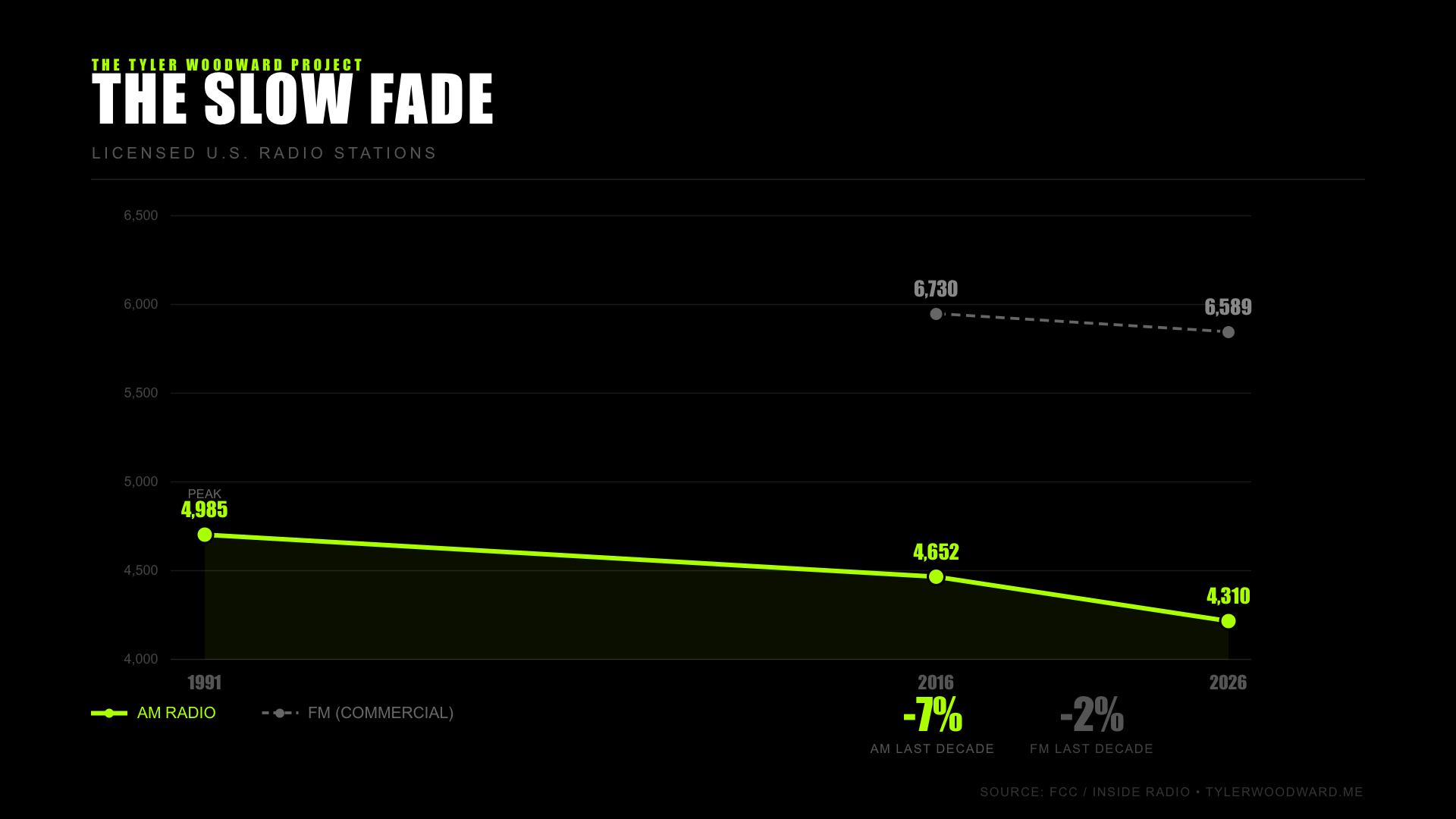
Some of these are mass closures. Groups like Cumulus and Town Square have shut down dozens of stations in just a few months. Like WFTW 1260 in Fort Walton Beach — over 70 years old, gone. Not sold, not rebranded. Just shut off. Why? Because the towers and land underneath them can be worth more than the signal itself.
The Real Estate That’s Killing AM
Look at the numbers. Cumulus sold the WMAL 630 transmitter site in Bethesda for $74 million. Clear Channel’s New Jersey AM sold its tower land for $51 million. And iHeart’s strategies are clear: sell the land, lease back the tower, run the station just enough to keep the license alive. The cost of keeping these stations on air is enormous. Power bills in New Jersey for a 50,000-watt station hit $8,000 to $9,000 a month. Plus towers need maintenance, FAA repainting, ground systems. Copper radials? Some stations dig them up and sell for scrap — a literal black market for radio hardware.

When more profit can come from real estate than broadcasting, guess what? The broadcast side gets discarded fast. The math doesn’t work anymore. It’s not just economics; it’s asset liquidation. Groups are quietly choosing to turn their stations into property plays.
Emergency Infrastructure: Why It Still Matters
And it’s not all about business. AM radio remains crucial during emergencies. FEMA’s national warning system relies on a network of just 77 stations called PEPs. About 85 percent are AM and built tough enough to stay on air during hurricanes, power outages, or wars. When hurricanes hit Puerto Rico in 2017 and knocked out 95 percent of cellular network towers, the local AM station WAPA 680 kept broadcasting. It was the only link for the community.
That’s not sentimental. That’s survival. AM radio’s long-range, battery-powered receivers need no internet, no cell towers. It’s the backup we forget about until an emergency hits. But Congress and FEMA? They’re not exactly prioritizing funding. The government has committed between $50 million and $115 million for PEP hardening, but that’s peanuts compared to the billions funneled into rural broadband projects.And the bill that could protect AM hardware in cars? It’s been stuck in Congress for years. The “AM for Every Vehicle Act” sees strong support, even endorsements from former presidents and the NAB. But no votes. Meanwhile, automakers like Tesla plan to ship new cars without AM or FM radios entirely.
Why the Infrastructure Matters More Than the Business
At the end of the day, the decline of AM isn’t just a story of changing listener habits. It’s about what assets these stations sit on, and whether those assets are worth more as broadcast licenses or prime land. The big owner groups have already made their call. They’re stripping down, selling off, and focusing on the digital or FM side.The real tragedy is that sectors like emergency communication depend on the very few remaining AM stations that are built to stand in a crisis. When a major storm or disaster hits, those stations matter. But the funding and policy decisions? They’re moving in the wrong direction.
FEMA’s warning system — built on AM radio — is widely considered critical. Congress knows it, too. Yet, the bills to support AM’s infrastructure struggle to get a vote. Meanwhile, a 105-year-old station in Los Angeles is losing its FM simulcast for a sports format that pays more.So yes, radio is dying. But it’s not just music and talk shows that are fading away. It’s the infrastructure, the real estate, and the emergency backbone that’s disappearing under our noses. Don’t forget what keeps stations alive when everything else fails.